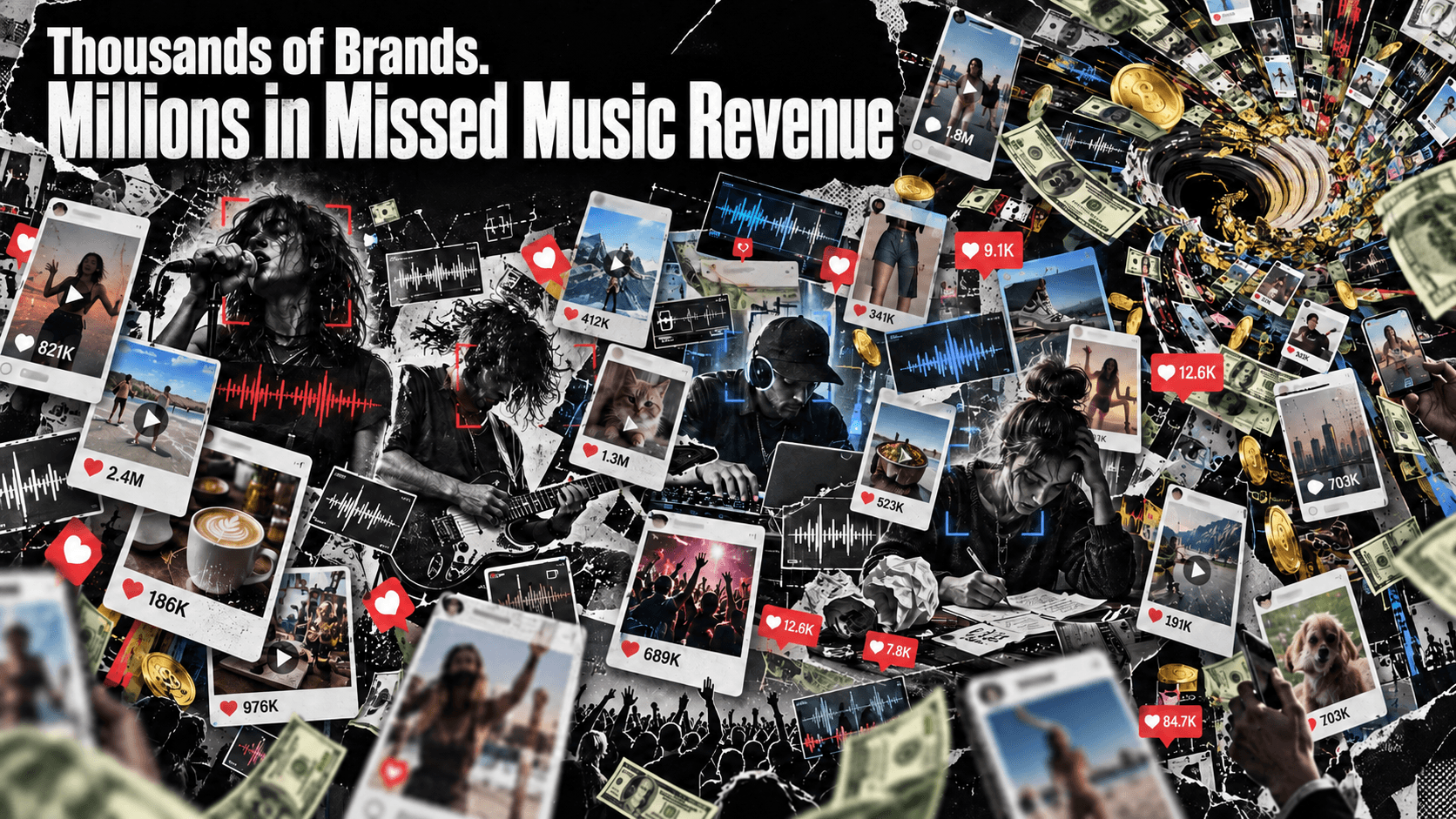
Thousands of Brands. Millions in Missed Music Revenue
Thousands of Brands. Millions in Missed Music Revenue

Nick Payne
Founder
Nick Payne
Founder
The music industry has a recovery problem.
Right now, much of the industry’s attention is focused on AI and rightly so, but while the industry debates future exposure, a measurable licensing problem is already sitting in public view.
Commercial brands use recorded music across social media every day. Rights holders know this. What remains poorly understood is the scale of that use and how little of it is converted into licensing decisions, enforceable evidence and recovered value.
Trakr's founding research analysed more than 350,000 TikTok posts published by over 1,000 commercial brands (including many global, household names) within an 18 month window, identified the music being used and mapped the relevant label and publishing interests to every piece of content:
79% of brands had published content for which there was clearly no evidence of a commercial music licence.
More than two billion views were attached to that content.
Over 8,000 titles from major and independent catalogues were involved.
Those posts generated more than $56 million in estimated media value for the brands in the dataset.
That final figure needs to be understood correctly.
It is not an estimate of lost sync revenue, recoverable damages or the amount rights holders could automatically invoice. It is an engagement-based estimate of the media value generated for brands around music uses requiring further investigation.
That distinction matters. Exposure is not the same as entitlement, and detection is not the same as recovery.
TikTok itself distinguishes between music pre-cleared for commercial use through its Commercial Music Library and music for which a business must obtain the appropriate permissions independently. But finding a commercial track outside that context does not, by itself, prove infringement. A brand may have a direct licence that is not publicly visible.
The specialist work begins after the music has been detected.
One brand post can raise several different questions:
Who controls the composition in the relevant territory?
Who controls the sound recording?
Was the use covered by a platform or direct licence?
If a direct licence exists, did it cover the term, territory, media and type of campaign involved?
Was the post organic, paid, boosted or subsequently repurposed?
Does the creative imply an association between the artist and the brand that was never approved?
These are different rights, revenue streams and commercial considerations. They do not share a single remedy.
Collecting-society income, where it applies, does not necessarily replace the direct fee associated with using a particular recording and composition to promote a product. Equally, a large audience does not automatically produce a large claim. Views are one valuation signal; the nature of the campaign, duration, territory, media, prominence of the music and rights controlled can matter just as much.
This is why sending rights holders thousands of flagged links does not solve the problem.
To turn a use into an actionable licensing opportunity, someone must verify the asset, establish ownership and control, examine possible licence coverage, preserve the source material, document the commercial context and assess whether the likely outcome justifies pursuing the case.
Then comes the most important decision: what should happen next?
The answer may be a prospective licence, a retrospective fee, a broader commercial discussion, removal of the content or no action at all. A brand using an artist’s music without adequate clearance today may still be a valuable licensing partner tomorrow.
Trakr was built to manage the work between detection and outcome.
We identify relevant commercial uses, map the rights, preserve an attributable evidence record and prioritise cases according to their legal and commercial strength. Rights holders review decisions rather than spreadsheets of social-media links.
We do not treat every flag as a claim. Volume without judgement creates noise, damages relationships and wastes internal resources. The objective is to identify the uses with the strongest combination of evidence, rights control, commercial value and recoverability—and progress those cases to a rational outcome.
Our work is offered on a no-recovery, no-fee basis. That allows rights holders to test what is happening across their catalogues without first building another internal monitoring and enforcement function.
AI may reshape music rights over the coming years. Unauthorised and inadequately licensed commercial use is creating measurable value for brands today.
The opportunity is not simply to detect more of it.
It is to recover the value that the evidence supports.

The music industry has a recovery problem.
Right now, much of the industry’s attention is focused on AI and rightly so, but while the industry debates future exposure, a measurable licensing problem is already sitting in public view.
Commercial brands use recorded music across social media every day. Rights holders know this. What remains poorly understood is the scale of that use and how little of it is converted into licensing decisions, enforceable evidence and recovered value.
Trakr's founding research analysed more than 350,000 TikTok posts published by over 1,000 commercial brands (including many global, household names) within an 18 month window, identified the music being used and mapped the relevant label and publishing interests to every piece of content:
79% of brands had published content for which there was clearly no evidence of a commercial music licence.
More than two billion views were attached to that content.
Over 8,000 titles from major and independent catalogues were involved.
Those posts generated more than $56 million in estimated media value for the brands in the dataset.
That final figure needs to be understood correctly.
It is not an estimate of lost sync revenue, recoverable damages or the amount rights holders could automatically invoice. It is an engagement-based estimate of the media value generated for brands around music uses requiring further investigation.
That distinction matters. Exposure is not the same as entitlement, and detection is not the same as recovery.
TikTok itself distinguishes between music pre-cleared for commercial use through its Commercial Music Library and music for which a business must obtain the appropriate permissions independently. But finding a commercial track outside that context does not, by itself, prove infringement. A brand may have a direct licence that is not publicly visible.
The specialist work begins after the music has been detected.
One brand post can raise several different questions:
Who controls the composition in the relevant territory?
Who controls the sound recording?
Was the use covered by a platform or direct licence?
If a direct licence exists, did it cover the term, territory, media and type of campaign involved?
Was the post organic, paid, boosted or subsequently repurposed?
Does the creative imply an association between the artist and the brand that was never approved?
These are different rights, revenue streams and commercial considerations. They do not share a single remedy.
Collecting-society income, where it applies, does not necessarily replace the direct fee associated with using a particular recording and composition to promote a product. Equally, a large audience does not automatically produce a large claim. Views are one valuation signal; the nature of the campaign, duration, territory, media, prominence of the music and rights controlled can matter just as much.
This is why sending rights holders thousands of flagged links does not solve the problem.
To turn a use into an actionable licensing opportunity, someone must verify the asset, establish ownership and control, examine possible licence coverage, preserve the source material, document the commercial context and assess whether the likely outcome justifies pursuing the case.
Then comes the most important decision: what should happen next?
The answer may be a prospective licence, a retrospective fee, a broader commercial discussion, removal of the content or no action at all. A brand using an artist’s music without adequate clearance today may still be a valuable licensing partner tomorrow.
Trakr was built to manage the work between detection and outcome.
We identify relevant commercial uses, map the rights, preserve an attributable evidence record and prioritise cases according to their legal and commercial strength. Rights holders review decisions rather than spreadsheets of social-media links.
We do not treat every flag as a claim. Volume without judgement creates noise, damages relationships and wastes internal resources. The objective is to identify the uses with the strongest combination of evidence, rights control, commercial value and recoverability—and progress those cases to a rational outcome.
Our work is offered on a no-recovery, no-fee basis. That allows rights holders to test what is happening across their catalogues without first building another internal monitoring and enforcement function.
AI may reshape music rights over the coming years. Unauthorised and inadequately licensed commercial use is creating measurable value for brands today.
The opportunity is not simply to detect more of it.
It is to recover the value that the evidence supports.
The music industry has a recovery problem.
Right now, much of the industry’s attention is focused on AI and rightly so, but while the industry debates future exposure, a measurable licensing problem is already sitting in public view.
Commercial brands use recorded music across social media every day. Rights holders know this. What remains poorly understood is the scale of that use and how little of it is converted into licensing decisions, enforceable evidence and recovered value.
Trakr's founding research analysed more than 350,000 TikTok posts published by over 1,000 commercial brands (including many global, household names) within an 18 month window, identified the music being used and mapped the relevant label and publishing interests to every piece of content:
79% of brands had published content for which there was clearly no evidence of a commercial music licence.
More than two billion views were attached to that content.
Over 8,000 titles from major and independent catalogues were involved.
Those posts generated more than $56 million in estimated media value for the brands in the dataset.
That final figure needs to be understood correctly.
It is not an estimate of lost sync revenue, recoverable damages or the amount rights holders could automatically invoice. It is an engagement-based estimate of the media value generated for brands around music uses requiring further investigation.
That distinction matters. Exposure is not the same as entitlement, and detection is not the same as recovery.
TikTok itself distinguishes between music pre-cleared for commercial use through its Commercial Music Library and music for which a business must obtain the appropriate permissions independently. But finding a commercial track outside that context does not, by itself, prove infringement. A brand may have a direct licence that is not publicly visible.
The specialist work begins after the music has been detected.
One brand post can raise several different questions:
Who controls the composition in the relevant territory?
Who controls the sound recording?
Was the use covered by a platform or direct licence?
If a direct licence exists, did it cover the term, territory, media and type of campaign involved?
Was the post organic, paid, boosted or subsequently repurposed?
Does the creative imply an association between the artist and the brand that was never approved?
These are different rights, revenue streams and commercial considerations. They do not share a single remedy.
Collecting-society income, where it applies, does not necessarily replace the direct fee associated with using a particular recording and composition to promote a product. Equally, a large audience does not automatically produce a large claim. Views are one valuation signal; the nature of the campaign, duration, territory, media, prominence of the music and rights controlled can matter just as much.
This is why sending rights holders thousands of flagged links does not solve the problem.
To turn a use into an actionable licensing opportunity, someone must verify the asset, establish ownership and control, examine possible licence coverage, preserve the source material, document the commercial context and assess whether the likely outcome justifies pursuing the case.
Then comes the most important decision: what should happen next?
The answer may be a prospective licence, a retrospective fee, a broader commercial discussion, removal of the content or no action at all. A brand using an artist’s music without adequate clearance today may still be a valuable licensing partner tomorrow.
Trakr was built to manage the work between detection and outcome.
We identify relevant commercial uses, map the rights, preserve an attributable evidence record and prioritise cases according to their legal and commercial strength. Rights holders review decisions rather than spreadsheets of social-media links.
We do not treat every flag as a claim. Volume without judgement creates noise, damages relationships and wastes internal resources. The objective is to identify the uses with the strongest combination of evidence, rights control, commercial value and recoverability—and progress those cases to a rational outcome.
Our work is offered on a no-recovery, no-fee basis. That allows rights holders to test what is happening across their catalogues without first building another internal monitoring and enforcement function.
AI may reshape music rights over the coming years. Unauthorised and inadequately licensed commercial use is creating measurable value for brands today.
The opportunity is not simply to detect more of it.
It is to recover the value that the evidence supports.